What changed at Google in 60 words
Between May 2025 and May 2026, Google turned search into an AI answer surface. AI Overviews reached 2.5 billion monthly users, AI Mode passed one billion. In parallel, Google launched full agentic commerce (Shopping Graph, delegated checkout, the UCP protocol). And in May 2026, an official guide settled the debate: optimizing for generative AI is doing good SEO, not a new discipline.
Market availability (July 23, 2026): AI Overviews is live in 200+ countries, and France joined on July 22, 2026, ending two years of regulatory hold tied to press neighbouring rights (Google France, July 22, 2026). The French rollout is progressive, on mobile and desktop, and the overview only appears on queries Google deems precise or complex enough. Agentic shopping (virtual try-on, agentic checkout, Business Agent) remains US-first and rolls out progressively. Most figures below reflect the US and earlier-deployed markets. The technical requirements are the same everywhere, and they also serve ChatGPT, Gemini and Perplexity.
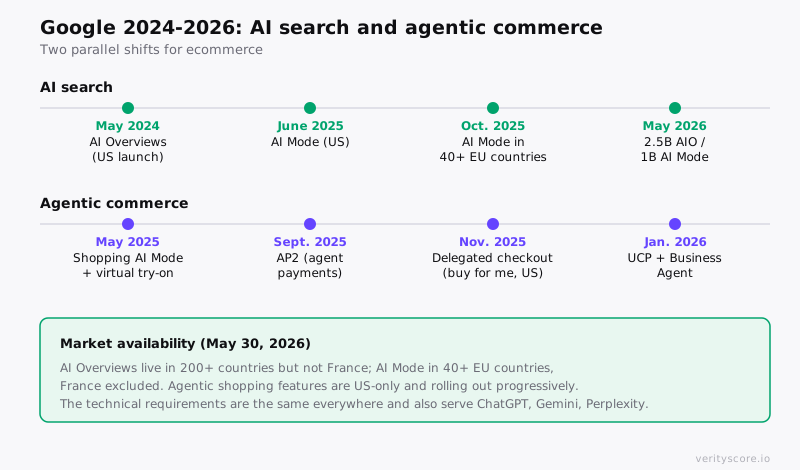
AI Overviews and AI Mode: what are they?
AI Overviews is the AI-generated summary shown at the top of Google results. Launched in the US at Google I/O in May 2024, it is now live in 200+ countries and 40 languages. At Google I/O 2026 (May 19, 2026), Sundar Pichai announced 2.5 billion monthly users.
AI Mode goes further: a fully conversational search tab powered by Gemini that replaces the list of blue links with a synthesized answer. Launched in the US in June 2025, expanded to 40+ European countries on October 8, 2025, it now exceeds one billion monthly users.
An important nuance: 2.5 billion users does not mean 2.5 billion people choosing AI. AI Overviews is a surface shown by default in Search. That is structurally different from a product like ChatGPT (800 million weekly active users, announced by OpenAI on October 6, 2025) or the Gemini app (900 million monthly users), where users go actively.
How Google selects cited content
Both surfaces rely on query fan-out: from a query, Google runs several related searches across subtopics, retrieves relevant pages, then generates an answer showing clickable links to sources. The system sits on top of Google’s existing quality and ranking systems. There is no secret lever: the content cited is the content classic SEO already surfaces well.
Who has access to these surfaces?
AI Overviews is live in 200+ countries and 40 languages. France was the last major holdout, excluded for regulatory reasons (DMA, GDPR, press neighbouring rights) after AI Mode reached 40+ European countries on October 8, 2025 without it. That exception ended on July 22, 2026, when Google rolled out both AI Overviews and AI Mode in France (Google France, July 22, 2026). The rollout is progressive, on mobile and desktop, and the overview only appears on queries Google deems precise or complex enough.
For ecommerce specifically, the agentic shopping features (virtual try-on, agentic checkout, Business Agent) launched US-first. Do not assume availability in your market: confirm before building a strategy that depends on a surface your customers cannot see.
What is the impact on organic traffic?
Two serious studies converge, even though Google publicly disputes their conclusions.
| Study | Metric | Figure | Scope |
|---|---|---|---|
| Pew Research (July 22, 2025) | Click on an organic result when an AI summary is present | 8% (vs 15% without) | 900 US adults, 68,879 searches |
| Pew Research | Click on a link inside the AI summary | 1% | Same sample |
| Pew Research | Share of searches triggering an AI summary (March 2025) | about 18% | Same sample |
| Ahrefs (February 4, 2026) | CTR drop for top-ranking pages when AI Overviews is present | -58% (vs -34.5% in April 2025) | 300,000 matched keywords |
Pew measures real panel behavior (strong reference). Ahrefs measures correlation on matched keywords (solid but correlational). Google replies that total click volume stays stable. The operational truth for a merchant: when AI answers instead of the click, being cited in the answer matters as much as ranking well.
Agentic commerce: Shopping Graph, delegated checkout, UCP
This is the most structural shift for ecommerce, and it is distinct from the search surfaces.
Shopping Graph. Google’s product catalog holds over 50 billion listings, with 2 billion updated every hour (Google figures). A merchant enters via Google Merchant Center and its product feed, or via Product structured data on the site.
Shopping in AI Mode. Announced at Google I/O in May 2025 (US): virtual try-on, price tracking, and most notably delegated checkout (“buy for me”), where Google’s agent completes the purchase on the merchant site via Google Pay, with user confirmation. Expanded for the holidays on November 13, 2025. Available in the US, rolling out progressively.
The agentic protocols (do not confuse them). The table below clarifies who backs what, because third-party content often mixes them up.
| Protocol | Backed by | Role | Status |
|---|---|---|---|
| UCP (Universal Commerce Protocol) | Google, with Shopify, Etsy, Walmart | Standardizes discovery-to-purchase for agents | Announced January 11, 2026 |
| AP2 (Agent Payments Protocol) | Google, then handed to the FIDO Alliance | Agent payment layer (Intent, Cart, Payment mandates) | Announced September 16, 2025 |
| ACP (Agentic Commerce Protocol) | OpenAI and Stripe | Checkout inside ChatGPT | Distinct from Google |
| MCP (Model Context Protocol) | Anthropic | Context and tools (not a payment protocol) | Distinct from Google |
Business Agent. Announced January 11, 2026, it is a brand assistant retailers activate in Merchant Center to answer product questions, comparisons and support (shipping, returns, warranties) directly in Search. US, invite-only for now.
What Google officially recommends (and rejects)
On May 15, 2026, Google published an official guide for optimizing for its generative AI features. Its main message is doctrinal, not technical: there is no new discipline to learn. Google states plainly that optimizing for generative AI search is still SEO.
The guide structures its recommendations into three pillars:
- Create valuable, non-commodity content for your audience.
- Build and maintain a clear technical structure (technical requirements, crawling best practices, page experience, reducing duplicate content).
- Optimize your local business and ecommerce details.
And it explicitly rejects several levers sold elsewhere as essential:
- llms.txt is not needed. Google: “You don’t need to create new machine readable files, AI text files, markup, or Markdown to appear in generative AI search.” Google does not fetch this file.
- No special schema.org markup is required for generative AI search.
- The guide warns against over-focusing on structured data as an AI citation lever.
A technical distinction not to miss: to prevent training of future Gemini models on your content, the token is Google-Extended (not “Googlebot-Extended”, which does not exist). Blocking it affects neither inclusion nor ranking in Search. To remove content from AI Overviews or AI Mode without leaving Search, Google points to nosnippet, data-nosnippet and noindex, not Google-Extended.
Structured data: what actually matters for shopping
Structured data is not an AI citation signal, but it remains decisive for merchant rich results and the Shopping Graph. Three up-to-date points:
- Product and Offer make the page eligible for merchant experiences (Shopping listings, price, availability). See our schema.org for ecommerce guide.
- Return policy must now include
returnPolicyCountry. Google recommends placing the standard policy underOrganization, overriding at product level only for exceptions. - Self-serving AggregateRating excluded. Google makes reviews an entity publishes about itself via
OrganizationorLocalBusinessineligible for stars (direct markup or embedded third-party widget).Product-level reviews remain eligible, and the aggregate rating must be visible on the page. A common trap: a misconfigured brand review widget produces no stars.
Playbook: 7 priority actions to prepare your store
Ordered by impact for a Shopify merchant, valid today (for ChatGPT, Gemini, Perplexity) and the day Google rolls out its AI surfaces in your market.
- Factual, unique product content. Replace vague marketing with verifiable facts (composition, dimensions, usage, proof). The number-one pillar of Google’s guide.
- Complete Product structured data. Price, availability, shipping, compliant returns (with
returnPolicyCountry), product-level reviews. Not for AI citation, but for Shopping listings and the Shopping Graph. - Up-to-date Merchant Center feed. The gateway to the Shopping Graph and, soon, the Business Agent. A complete, fresh feed is non-negotiable.
- Open access for AI crawlers. Check that your
robots.txtdoes not block the agents you want citing you. Decide on Google-Extended consciously based on your stance on training. - Customer reviews visible on the page. An aggregate rating must be readable in the HTML, not only injected by a JavaScript widget, and compliant with self-serving rules.
- A buyer-question answers page. Anticipate real questions (shipping, compatibility, comparison) with direct factual answers. That is what query fan-out goes looking for.
- Clean technical structure. Decent page experience, no duplicate content, crawler-accessible rendering. The shared foundation of SEO and GEO.
Take action
Verity Score audits your store on these exact signals (structured data, crawl access, visible reviews, readability by AI engines) and gives you concrete Shopify recommendations, with the responsible actor named.
Related articles
- GEO vs SEO: what is the difference for ecommerce?
- Agentic commerce explained
- schema.org structured data for ecommerce
- Google AI Optimization Guide: breakdown