An AI system can cite valid pages and describe the wrong company
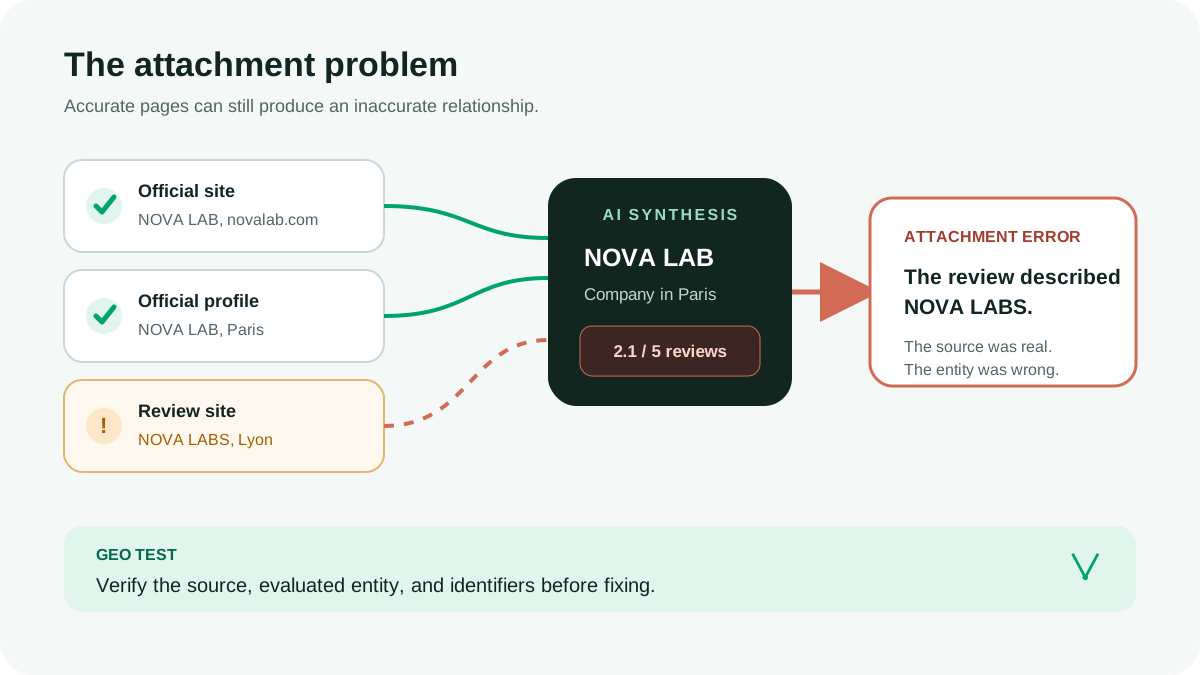
Across several sites we analyzed, we observed the same class of problem: two similar names or domains appear in the available sources, then an answer attaches a review, reputation claim, or business fact to the wrong entity.
We are not publishing a rate. The sample was not designed to measure prevalence, and the stores involved did not authorize public identification. The observation still defines a useful test: a brand is not fully prepared for generative search when facts about it cannot be distinguished from facts about another company.
This risk is more specific than the generic label “hallucination.” An answer may cite real pages that are relevant to part of the question and still create a relationship that does not exist in any source considered separately.
On May 28, 2026, a German court documented that exact failure mode.
The Munich case from May 28, 2026
In case 26 O 869/26, the Munich I Regional Court examined Google AI Overview answers about two publishing companies.
A query that combined a company name with the German term for a fraud scheme triggered an affirmative answer. The AI Overview described questionable business practices, subscription traps, and connections to other companies.
The GEO-relevant part of the judgment is narrow but important. Some relationships in the generated summary were not present in the cited pages. The answer did more than list links. It organized several results, connected their content, and produced new claims.
The court granted interim relief against specified statements and treated the generated summary as attributable to Google. The decision has clear limits:
- it is a German interim proceeding;
- it concerns specific statements and a specific record;
- it does not reveal Google’s internal algorithm;
- it does not prove that schema.org markup would have prevented the error;
- it does not make every inaccurate answer legally equivalent.
What it establishes for this analysis is narrower: a generative synthesis can create an association that is absent from its individual supporting sources.
What is established and what remains an operational model
Google says its generative Search features use techniques that include retrieval-augmented generation and query fan-out. The system can run several related searches, retrieve pages from the index, and generate an answer grounded in those results.
Google does not publish the exact sequence that caused the Munich error. It would therefore be excessive to say that similar names caused it or that adding sameAs would have fixed it.
For audits, we use a four-stage model:
- Retrieval. Which pages and records are available for the query?
- Entity resolution. Which company, person, brand, or product does each source describe?
- Fact attachment. Which entity receives the review, price, allegation, or policy?
- Synthesis. Does the final answer preserve those attachments correctly?
This model does not claim to reproduce the architecture of Google, OpenAI, or any other engine. It separates observable retrieval, interpretation, and generation failures.
Collision one: company identity
A company can legitimately have several names: legal name, public brand, site name, former name, abbreviation, and domain. Ambiguity grows when those names are used without a clear relationship or another company occupies an almost identical name.
Google recommends declaring the site name with WebSite markup on the home page. Its systems also consider og:site_name, the title, headings, and other home-page text. Google asks for a unique, accurate, and consistently used name. alternateName is for real alternatives, not a keyword list.
For the business, Organization or OnlineStore can describe:
| Property | Verifiable role |
|---|---|
name | Public name used by the business |
alternateName | Another name genuinely used, when applicable |
legalName | Registered name when different from the public name |
url | Official site, which Google says helps uniquely identify the organization |
logo | Representative, accessible logo |
sameAs | Official profiles or third-party pages about the same organization |
email, telephone, address | Applicable, consistent contact details |
vatID, taxID, iso6523Code | Applicable legal identifiers |
Only accurate, relevant properties should be published. An invented identifier or an uncontrolled profile creates more ambiguity.
Markup also does not replace visible consistency. If JSON-LD says “Nova Lab,” the title says “Nova Labs France,” the social account says “Nova Commerce,” and legal notices say “NL Digital SAS” without explaining those relationships, a parser receives four labels and no clear hierarchy.
Collision two: product identity
A business can be identified correctly while its products remain ambiguous. This is common with variants, products sold by several merchants, private labels, and catalogs where an internal SKU replaces a global identifier.
The product identity contract includes at least:
- brand;
- GTIN when the product has one;
- manufacturer part number when applicable;
- internal SKU;
- canonical URL;
- parent product and variant;
- seller or manufacturer when they differ;
- consistent values across Shopify, the page, structured data, and feeds.
A SKU is usually local to one merchant. It helps locate a line in Shopify, but it may not identify the product across several sellers. A valid GTIN is designed to provide that cross-merchant identity.
Google recommends using Product structured data and Merchant Center together when applicable. That does not mean both sources are always merged or that a correct value in one automatically repairs the other.
Why reviews are especially sensitive
A review can evaluate three different objects: the company, the merchant that sold the item, or the product itself. Five stars without the evaluated entity are not enough.
Google Merchant Center says product ratings can aggregate sources from merchants, review aggregators, review sites, and Google users. Matching relies primarily on unique product identifiers, especially GTIN.
When GTIN is missing or inaccurate, Google attempts matching with SKU, brand plus MPN, or product URL. Google says these fallback methods result in fewer reviews being correctly associated. It does not say they necessarily attach a review to another product. The accurate conclusion is that incomplete identifiers make matching less reliable, not that they explain every observed error.
The checks are direct:
- Is the GTIN identical in Shopify, Merchant Center, and the review feed?
- Is the brand spelled the same way everywhere?
- Does the MPN come from the manufacturer, or was it replaced with an internal SKU?
- Is the review attached to the
Product, the merchant, or theOrganization? - Does the product URL in the feed resolve to the correct canonical page?
For ChatGPT Shopping, OpenAI says review summaries can come from public websites and that reviews and ratings are not verified by OpenAI. This justifies monitoring. It does not mean that one Shopify field controls the summary.
Our analysis of customer reviews that are invisible to AI engines covers the other side of the problem: a review can belong to the right product and still be missing from the served HTML.
A five-query test protocol
Do not test only “what do you know about my brand?” A vague prompt combines awareness, identity, products, and reputation.
Use five separate queries:
- Exact brand name. Check the proposed domain, activity, country, and legal company.
- Brand name plus reviews. Determine whether reviews concern the company, merchant, or a product.
- Brand name plus priority product. Check the brand, seller, price, variant, and sources.
- Brand name plus a known namesake. See whether the answer separates the two entities explicitly.
- Product name plus brand. Check whether reviews and attributes belong to the correct reference.
Record the following for every test:
| Field | Why it matters |
|---|---|
| Date and time | Answers and indexes change |
| Country and language | Retrieved sources can vary |
| Signed-in state | Personalization may influence the answer |
| Exact query | A rewrite may change query fan-out |
| Complete answer | A cropped screenshot can remove a qualification |
| Every cited URL | Each claim must be verified in the source |
| Expected entity | Company, merchant, or product |
| Verdict | Correct, ambiguous, misattached, unverifiable |
One incorrect answer justifies investigation, not a platform-wide conclusion. Repeat the test in a clean session and verify each source before assigning a cause.
Remediation order
1. Locate the failure
Does the cited page actually contain the claim? Does it describe your company or a namesake? Did the generated answer create a relationship that is absent from the page?
2. Stabilize the site name
Align WebSite.name, WebSite.url, og:site_name, the home-page title, and the visible brand name. Add only genuine alternateName values.
3. Describe the organization
Use Organization or OnlineStore with the public name, legal name when different, official domain, logo, official profiles, and applicable identifiers. Point internal references to a stable entity identifier when the architecture supports it.
4. Align product identifiers
Compare Shopify, JSON-LD, Merchant Center, and the review feed. Fix GTIN, brand, and MPN first, then SKU, URLs, and variants.
5. Correct controlled sources
Update the profiles, directories, or feeds that the business controls. Do not create fake profiles or solicit fake reviews to manufacture mentions.
6. Report the false claim
Use the platform’s feedback or appeal mechanism with the query, screenshot, exact claim, and contradicting source. Seek appropriate professional advice when the error creates legal or reputational harm.
7. Request recrawling and repeat the test
After corrections, validate the page, request recrawling when the tool allows it, and repeat the five queries with the same scope. Source corrections may not appear immediately because caches, indexes, and third-party systems have different update cycles.
What the method can and cannot improve
It can:
- reduce contradictions in sources controlled by the brand;
- make the company and products easier to distinguish;
- improve review matching in feeds that use product identifiers;
- create an evidence record for a correction request;
- detect regressions after a domain, name, or catalog change.
It cannot:
- guarantee a generative answer;
- change a third-party page without its publisher;
- force Google, OpenAI, or another engine to use a source;
- turn schema.org into a guaranteed ranking factor;
- prove that a correction caused a future citation.
What Verity Score checks
Verity Score starts with the Shopify store and compares facts exposed in the page, HTML, structured data, reviews, and available commerce surfaces. The audit can flag a name, identifier, or rating that disagrees across those layers and prepare a merchant-reviewed correction.
It does not monitor every Google answer and cannot modify an AI Overview. Its role is upstream: reduce contradictions the brand controls and make each fact easier to attach to the correct product.
You can run the audit in the Verity Score Shopify app. For the broader Google strategy, read the 2026 Google AI guide.
The new GEO question
GEO has often been framed as a readability problem: can the machine find the information?
The Munich case adds a second, harder question: does the machine attach that information to the correct entity?
A clear page remains necessary. As answers combine more sources, identity becomes trust infrastructure. The useful goal is not to “feed the AI.” It is to publish enough verifiable consistency that a name, product, review, and policy do not change owners during synthesis.