AEO in 60 words
Answer Engine Optimization (AEO) is the practice of structuring a site to be extracted and cited as a direct answer by answer engines: Google AI Overviews, ChatGPT, Perplexity, Copilot, Gemini, voice assistants. While SEO targets blue-link rankings, AEO targets a textual citation or inclusion in a generated response. Content moves from “clickable” to “extractable”.
Why this article exists
The English-language AEO articles published in 2026 often reuse 2024 statistics, rarely cite the founding Princeton paper, ignore the e-commerce layer and skip any public criticism of the concept. This guide corrects three things: dated verifiable sources (Ahrefs Q1 2026, Adobe April 2026, McKinsey 2025, Conductor November 2025), explicit e-commerce focus, and an acknowledged critique section (Fishkin, Mueller, Schwartz).
Where does the term AEO come from?
The term has circulated in the US SEO sphere since 2019-2020, driven by the explosion of Google featured snippets (2014-2016), People Also Ask, then voice search. HubSpot, Brafton and SmartBug published the first “Answer Engine Optimization” guides in 2020-2021. There is no single inventor.
The term GEO (Generative Engine Optimization) has a clearer authorship: the paper GEO: Generative Engine Optimization by Aggarwal, Murahari, Rajpurohit et al. (Princeton University), published on arXiv on November 14, 2023 and presented at ACM SIGKDD 2024. It is the first academic formalization of the problem with a reproducible benchmark (GEO-bench, 10,000 queries, 9 optimization methods).
AEO vs GEO in one sentence: AEO focuses on direct-answer surfaces (snippets, voice, AI Overviews, chatbots); GEO covers all generative engines including agentic commerce. In practice, 80% of best practices overlap. We go deeper in our dedicated article: AEO vs GEO vs SEO: clarifying the acronyms in 2026.
The 4 answer surfaces AEO targets
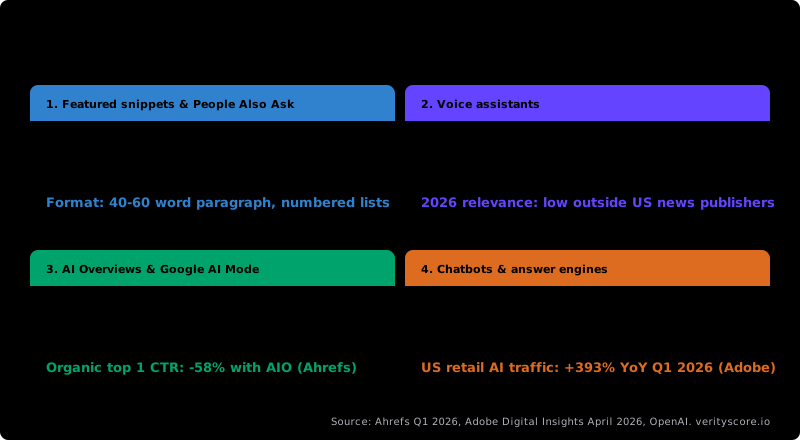
AEO is not one surface but four distinct channels, each with different signals and constraints.
1. Featured snippets and People Also Ask (classic Google SERP) The original surface. 40-60 word paragraphs, numbered lists, short tables. Still active in 2026, but less strategic as Google progressively absorbs these formats into AI Overviews.
2. Voice assistants (Google Assistant, Siri, Alexa)
Legacy from 2017-2020. Uses speakable schema (still in Google beta, US only, news only). Real-world relevance is limited in 2026 except for English-language news publishers.
3. AI Overviews and Google AI Mode Deployed in the US in May 2024, extended to 200 countries in May 2025. Conductor measures an AI Overview presence on 25.11% of queries in Q1 2026 (up from 13.14% in March 2025) over 21.9 million queries analyzed. AI Mode reached 75 million daily active users by end of 2025 with 93% of queries ending without an external click.
4. Chatbots and conversational answer engines ChatGPT, Perplexity, Claude, Gemini, Copilot, You.com. OpenAI disclosed 900 million weekly ChatGPT users in February 2026, up from 400 million one year earlier. Perplexity hovers around 34 million monthly active users. Gemini crossed 750 million MAUs on its app.
An effective AEO signal must work across at least three of these surfaces. Optimizing for featured snippets only in 2026 means addressing 10% of the problem.
2026 numbers to know (fresh sources only)
Organic CTR collapses when an AI Overview appears
Ahrefs published in February 2026 an update to its 300,000-keyword study: average top-1 CTR drops 58% when an AI Overview is present, up from -34.5% in the original April 2025 study. Concretely, top-1 informational CTR went from 0.076% (December 2023) to 0.039% (December 2025), and on AIO-triggering keywords from 0.073% to 0.016%.
Pew Research had documented in July 2025 across 68,879 real queries: 8% traditional click-through with an AI summary present, vs 15% without. Clicks on sources cited within the summary itself account for only 1%.
AI Overview citations no longer come from the top 10
Ahrefs published in Q1 2026 a study on 863,000 keywords and 4 million AIO URLs: only 38% of citations come from Google’s top 10, down from 76% in July 2025. Thirty-one percent come from positions 11-100, and 31% are outside the top 100. YouTube became the most-cited domain, accounting for 18.2% of citations outside the top 100. The shift followed Gemini 3’s activation as default AIO model on January 27, 2026.
This changes the strategic read: ranking in Google’s top 10 remains useful but no longer enough to be cited by AI.
E-commerce AI traffic is exploding
Adobe Digital Insights published on April 16, 2026 that AI-referred traffic to US retail sites grew 393% year-over-year in Q1 2026. During the 2025 holidays, growth hit +693% in November-December. 65% of AI shopping users say they feel more confident in their purchase; 68% are less likely to return the product.
Semrush measures across 13 months of data that an LLM visitor is worth on average 4.4x more than an organic search visitor, with an 18% conversion rate for Semrush customers tracking LLM referrals.
Half of consumers have already switched
McKinsey surveyed 1,927 US consumers in August 2025: 50% already use some form of AI search, with a projected $750 billion revenue impact by 2028. Notable: only 5-10% of sources cited by AI platforms are the brand’s own site; the remaining 90% are publishers, UGC, third-party reviews and affiliates. This means AEO can’t be limited to the brand’s site; you also need to appear in third-party sources.
Numbers to handle carefully
Three stats recur across AEO articles and deserve caveats:
- “62% of 2026 searches involve voice”: we did not find a solid primary source. Avoid or source better.
- “FAQPage multiplies AI citations by 3.2x”: Frase.io, SEOscore, SEO agency figures. No peer-reviewed controlled study. Directional signal, not proof.
- “80% of ChatGPT citations aren’t in Google’s top 100”: circulated claim. Contradicted by Ahrefs Q1 2026 (38% come from top 10, 31% from 11-100, 31% outside top 100). Worth reframing.
Is AEO a real shift or marketing rebranding?
The question agencies avoid and practitioners ask in private. Both camps.
The “buzzword” camp
Rand Fishkin (SparkToro, ex-Moz) counted 15 different acronyms in a single day of LinkedIn discussions: AEO, GEO, AIO, LLMO, GAIO, AISO, SXO, AAO, etc. His argument: “SEO professionals already possess the necessary technical skills for this expanded approach”. He defends “Search Everywhere Optimization” as an honest alternative that keeps the “E” of SEO by redefining “Engine” to “Everywhere”.
John Mueller (Google Search Advocate) stated that new acronyms “signal spam tactics” per ppc.land coverage.
Searchable.com highlights a sobering data point: AI traffic remains around 1.08% of total traffic despite +357% YoY growth; organic dropped only 2.5% in absolute terms. The effect is real but modest at budget scale.
The “it’s really different” camp
Eli Schwartz defends in AEO is not SEO 2.0 three solid structural arguments:
- Rankings no longer exist in generative responses (infinite surface of personalized answers).
- Visibility can’t be manufactured as easily: LLMs favor established entities, making brand awareness a prerequisite rather than a goal.
- Citations don’t behave like backlinks (non-linear, non-cumulative, volatile).
Mark Williams-Cook published a controlled experiment in February 2026: an address hidden only in an invalid JSON-LD (with no visible equivalent on the page) was extracted by both ChatGPT and Perplexity. Conclusion: LLMs tokenize JSON-LD as plain text, not structured data. FAQPage schema doesn’t directly influence citations. What matters is the visible Q/A on the page, which often mirrors the schema.
Our position
AEO covers roughly 80% classic SEO and 20% genuinely new. The 80%: quality content, E-E-A-T, backlinks, clean architecture, schema.org, speed, indexing. The 20%: the 6 levers detailed in the next section. The name matters less than the split.
AEO articles promising “the new discipline that replaces SEO” sell dreams. Articles saying “it’s just rebranded SEO” miss the real shift. The AEO name is useful if it helps unlock dedicated budget for the 20% that’s changing. If it’s used to rebill bad SEO twice, that’s a problem.
6 AEO levers that work in 2026
These six levers have at least one strong signal (study, experiment, agency proprietary data) moving AI citation rate. Others (Speakable, HowTo, noai meta) are covered below in “what to ignore”.
1. 40-60 word answer blocks at section start
The Princeton KDD 2024 paper shows that the best optimization methods (citations, statistics, sources) increase AI visibility by up to +40%, and by +115% for poorly-ranked pages. BrightEdge observed in 2026 that 55% of AI Overview citations come from the first 30% of the page.
Practice: every H2 is phrased as a question or a closed topic, and the first sentence that follows contains the answer in 40-60 words. The rest of the paragraph develops. Inverted pyramid applied to LLM chunking.
2. Complete schema.org Product, Organization, Article
Schema doesn’t guarantee a citation. It guarantees the engine understands what it reads. For an e-commerce site in 2026, minimum stack:
ArticleorBlogPostingwithauthor(Person with sameAs LinkedIn),datePublished,dateModifiedOrganizationwith verifiedsameAsprofiles (LinkedIn, official social profiles, Wikidata only when the entity exists and is legitimate),knowsAbout, logo as ImageObjectProductwithOffer,Brand,AggregateRating,hasMerchantReturnPolicy,shippingDetailsBreadcrumbListon deep pages
Google formalized in November 2025 that hasMerchantReturnPolicy and shippingDetails can be declared at Organization level and that structured-data ↔ Merchant Center feed consistency becomes an explicit product approval factor. Details in our Schema.org for Shopify guide.
3. Segmented AI crawler access
2026 robots.txt is no longer an all-or-nothing. You must distinguish training bots (which can be blocked without visibility loss) from live citation bots, which should be allowed when the goal is search/live-fetch eligibility unless legal, security or IP-strategy constraints apply.
| Bot | Role | Default recommendation |
|---|---|---|
GPTBot | OpenAI training | Block or allow depending on IP strategy |
OAI-SearchBot | ChatGPT Search indexing | Allow |
ChatGPT-User | Live on-demand fetch | Allow |
ClaudeBot | Anthropic training | Block or allow depending on IP strategy |
Claude-User / Claude-SearchBot | Live fetch / index | Allow |
PerplexityBot | Perplexity index | Allow |
Google-Extended | Gemini training opt-out | Block if no training desired |
Googlebot | Google index + AIO | Allow (blocking = invisible) |
Applebot-Extended | Apple Intelligence training | Per strategy |
Full details and config examples in our robots.txt and AI crawlers guide. Caveat: Perplexity-User ignores robots.txt per Perplexity’s official position (justified by human user trigger), so blocking Perplexity globally is more complex than a simple Disallow.
4. Disambiguated organization entity
Organization with sameAs pointing to LinkedIn Company, official social profiles, Crunchbase where relevant, and Wikidata only when a verifiable entity already exists or the brand meets notability criteria. knowsAbout declares expertise domains. Google documents sameAs as an external URL with additional information about the organization; it is an entity-disambiguation signal, not a rich-result or AI-citation guarantee.
Author side: Person with sameAs LinkedIn, verifiable author profile. Google added an “Authors” section to the Search Central (updated December 10, 2025) specifying best practices. Agency Qwairy claims +40% AI citations with verified author credentials; directional agency signal, not controlled study, but consistent with E-E-A-T logic.
5. Quarterly freshness on strategic pages
AirOps reports (via Semrush 2026) that 95% of ChatGPT citations come from content published or updated in the last 10 months. BrightEdge measures pages updated under 60 days old have 1.9x the probability of appearing in AI responses.
Practice: a quarterly review calendar for strategic pages (pillar blog posts, KB, top product pages). Not a full rewrite: refresh numbers, verify sources, add updates, bump dateModified in schema.
6. Earned citations: being cited elsewhere
Cubitrek and several 2026 agencies converge: approximately 72% of AI citations come from earned media (third-party articles, podcasts, Reddit, YouTube, Wikipedia, industry listicles) and not from the brand’s own site. McKinsey (August 2025) puts brand-owned sources at only 5-10%.
Concretely: digital PR, Wikipedia/Wikidata contributions when legitimate and sourced, appearance in “top X” industry listicles, podcasts, interviews. AI citation is a byproduct of multi-source reputation. This is modern SEO, with doubled weight.
AEO for e-commerce: the product layer no one addresses
AEO guides cover editorial content (articles, FAQ, landing pages). Almost none address the product layer. This is our differentiating angle.
The problem: an AI agent reads a catalog, not a blog
When a user asks ChatGPT “recommend me a firm 160x200 mattress under 800 euros”, the agent doesn’t read your blog article “How to choose a mattress”. It needs extractable structured attributes on a product page: size, firmness, price, availability, return policy, verified reviews. Your product page must be citable as a final answer, not as content to explore.
AEO e-commerce checklist
Structured attributes (complete schema.org Product)
name,description(minimum 150 words, factual, no vague marketing)brand(Brand with URL)gtin/mpn/sku(at least one)image(multiple ratios 16:9, 4:3, 1:1, 500x500 minimum for Merchant Center)offers:price,priceCurrency,availability,priceValidUntilhasMerchantReturnPolicy(can be at Organization level since November 2025)shippingDetailsaggregateRatingwithratingValue,reviewCount,bestRatingreview(at least 3-5 recent reviews in JSON-LD)
Product content
- H2 “Key specifications” with specs in definition list (
<dl>) - H2 “Product FAQ” with 5-8 Q/A (FAQPage schema) on real buyer questions
- H2 “Shipping and returns” with explicit delays, linked policies
- Internal comparisons when relevant (table)
- Detailed use cases (“ideal for X”, “avoid if Y”)
Agent protocols
- UCP (Universal Commerce Protocol) manifest: see UCP on Shopify
- ACP (Agentic Commerce Protocol) OpenAI + Stripe: see ACP
/.well-known/agent-card.jsonif MCP agents available- Up-to-date Merchant Center feed (500x500 image required since April 14, 2026 update)
Server-rendered reviews
Shopify review apps (Yotpo, Judge.me, Loox) often render stars via JavaScript only. AI crawlers don’t always execute JS. You need server-side JSON-LD AggregateRating injection. Details in our AggregateRating article.
The e-commerce gap: 89% of e-commerce sites implement SKU schema poorly according to NeuronWriter. It’s an immediate differentiator for merchants who fix it.
What to ignore in 2026
By symmetry: what AEO guides still cite that brings nothing, or is deprecated.
HowTo schema: retired by Google in September 2023 on desktop, extended mobile in 2024. In 2026, the markup is ignored, no longer appears as rich result. Replace with semantic <ol><li> and explicit H2/H3.
Speakable schema: still in Google “beta” since 2019, US only, news only. Near-zero value for a non-news English site and zero for non-English.
FAQPage rich result: restricted since August 2023 to government and health sites. The markup remains useful for LLMs parsing JSON-LD, but a SERP rich result is unlikely for most commercial sites. No reason to remove it, no reason to expect SERP miracles.
noai meta tag: invented by DeviantArt in 2022, no W3C standard, OpenAI and Google don’t officially document respect. Use explicit user-agents in robots.txt instead (GPTBot, ClaudeBot, Google-Extended).
llms.txt: Jeremy Howard spec from September 3, 2024. Over 844,000 sites publish a /llms.txt according to BuiltWith. No major actor (OpenAI, Anthropic, Google, Perplexity) has officially announced reading it as first-order input. Nuance: ChatGPT and Claude can fetch it on demand. Low implementation cost, no negative effect, but not a “must do” to sell to a client. Full details in llms.txt guide.
Measuring AEO
Classic web analytics don’t see AI citation. GA4 doesn’t tell you if ChatGPT recommended your product. Three measurement layers exist.
Layer 1: AI Share of Voice
Tools that query ChatGPT, Perplexity, Gemini, Claude on a panel of queries and measure brand mention frequency vs competitors:
- Profound (enterprise, plans 99-399 dollars per month)
- Semrush AI Visibility Toolkit (included in Semrush Business)
- AthenaHQ, Peec AI (Berlin, February 2025), Scrunch, Daydream
- Ahrefs Brand Radar
- HubSpot AEO Grader (free, qualitative)
Layer 2: AI referral traffic
ChatGPT, Perplexity and Claude send a referrer in most non-stripped browsers today, but 70% of visits arrive without referrer because AI extracted the answer and the user doesn’t click. Server-side method to implement: see our Why GA4 is lying about your AI traffic guide.
Layer 3: Technical citability audit
Before measuring Share of Voice, you must verify your content is extractable, and measuring it properly means testing several engines, not just one (full method in the 2026 Share of AI Voice guide). That’s our stance at Verity Score: a store with a low technical AEO score starts with a measurable technical handicap; part of the content budget can remain invisible if product proof is not extractable. The Verity Score audit scans 100+ signals (schema, crawlers, server-side AggregateRating, llms.txt, UCP, ACP) and is available in the public Shopify app.
Where to start: 5 prioritized actions
Starting from zero, the order that yields most results for least effort:
- Audit AI crawler access (30 minutes). Open your robots.txt. Verify OAI-SearchBot, PerplexityBot, Claude-User, ChatGPT-User, Claude-SearchBot aren’t blocked. Decide your position on GPTBot and ClaudeBot (training vs not).
- Complete schema.org Product (2-4 hours depending on theme). Add
hasMerchantReturnPolicy,shippingDetails, verifyAggregateRatingis server-side HTML-injected. - Add Organization with verified sameAs profiles and knowsAbout (1 hour). Link official social profiles, add Wikidata only if a legitimate item already exists or the brand is genuinely notable, then declare 5-10 expertise domains.
- Restructure 5 strategic pages as answer blocks (2 hours per page). H2 as question, first sentence = 40-60 word answer, specs in lists or tables,
dateModifiedup to date. - Run a technical AEO audit to get a baseline score and identify the 20% that drives 80% of gains. The Verity Score audit covers this ground for Shopify stores, inside the Shopify app.
Conclusion
AEO is neither a revolution nor a buzzword. It’s a pragmatic framework for addressing the 20% of SEO that changed with the rise of generative answer engines. Fundamentals (quality content, E-E-A-T, authority, structure) remain intact. What changes: technical signals (modern schema, segmented AI crawlers, disambiguated entities, freshness, earned citations), measurement (AI Share of Voice instead of ranking) and target surface (4 surfaces instead of a single SERP).
Merchants who act now on these 20% capture the advantage while others debate the name. The rest will follow.
Related articles
- AEO vs GEO vs SEO: clarifying the acronyms in 2026 - Precise comparison of the three concepts
- What is GEO (Generative Engine Optimization)? - 2026 Generative Engine Optimization guide
- GEO vs SEO: what’s the difference? - SEO / GEO comparison
- GEO Readiness: 9 factors - Technical factors determining AI visibility
- Schema.org Product on Shopify - Product / Offer / AggregateRating stack
- robots.txt and AI crawlers - Complete 2026 configuration
- E-E-A-T signals for AI - How engines evaluate authority
- Why GA4 is lying about your AI traffic - Server measurement method
Kamil Kaderbay, founder of Verity Score. Former founder Snackeet (AI conversational commerce, acquired 2024). 10+ years of marketing and product in e-commerce and AI.