Video : 6 minutes to understand GEO
Why this guide
The mainstream AI conversation in 2026 centers on ChatGPT and Perplexity. That’s a narrow view. More than 15 LLMs impact Shopify product page visibility today, and they don’t all work the same way. Some use Google Merchant Center feeds, others read raw HTML via proprietary crawlers, others navigate live via browser agents.
For an e-commerce merchant, optimizing only for the 4 most famous leaves out half the channels. And crucially, it completely misses LLMs growing rapidly in Europe (Mistral Le Chat), on WhatsApp (Meta AI), on X (Grok) or in Asia (Qwen, DeepSeek).
This guide catalogs the 15 AI systems that matter for e-commerce in 2026, their data collection mechanics, and the surfaces where your store can appear.
The 15 LLMs that matter for e-commerce in 2026
ChatGPT (OpenAI)
- Users: 900 million weekly active users (confirmed by OpenAI late February 2026, source TechCrunch), 50 million paying subscribers
- Country: United States
- Commerce: ChatGPT Shopping (carousel + checkout via ACP for Etsy, Glossier, SKIMS, Spanx, Vuori, Target, Sephora, Nordstrom, Lowe’s, Best Buy, Home Depot, Wayfair)
- Product data: hybrid : carousel 83% fed by Google Shopping (Peec AI study), text answers via Bing (87% match Bing top 20)
- Crawlers: GPTBot, ChatGPT-User, OAI-SearchBot : none execute JavaScript
- Europe relevance: strong, no localization specific
Gemini (Google)
- Users: 750 million monthly active users on the Gemini app (Alphabet Q4 2025 earnings)
- Country: United States
- Commerce: native UCP integration,
native_commerceflag in Merchant Center, direct “Buy” button in Gemini and Google AI Mode - Product data: hybrid : Google Search + Merchant Center feed
- Crawlers: Googlebot (full JavaScript rendering via evergreen Chromium), Google-Extended (training opt-out)
- Europe relevance: very strong, Gemini is the default assistant on Android
Google AI Overviews and Google AI Mode
Two distinct Google surfaces worth treating separately.
- AI Overviews: summary above organic results, 2 billion monthly users (Google Q2 2025 earnings), appears in ~14% of shopping queries in 2026
- AI Mode: conversational mode with fan-out (up to 16 parallel queries), 75 million daily users, Direct Offers shopping ads launched February 2026
- Data: grounded on Google Search index + Merchant Center for products
- CTR impact: AI Overviews reduce organic CTR by 58% on average (Ahrefs 2026 update)
Perplexity
- Users: 100 million+ MAU (Financial Times April 2026), 450 million ARR
- Country: United States
- Commerce: Perplexity Shopping, Buy with Pro, Snap to Shop, PayPal, Shopify, BigCommerce integrations
- Product data: hybrid : PerplexityBot on HTML + direct feed for merchants enrolled in the Perplexity Merchant Program + Shopify Catalog integration
- Crawlers: PerplexityBot and Perplexity-User : neither executes JavaScript
- Comet: agentic browser since March 2026, free on iOS/Android/Windows/Mac, scrapes HTML live
- Europe relevance: strong, amplified by Snapchat integration since January 2026
Claude (Anthropic)
- Users: no official MAU published by Anthropic, 14 billion annualized ARR as of late February 2026 (source TechCrunch)
- Country: United States
- Commerce: no native shopping surface, but Claude powers many commerce MCP agents and is the engine behind Perplexity’s Comet Agent (Sonnet 4.6 for Pro, Opus 4.6 for Max)
- Product data: crawl for training and search
- Crawlers: ClaudeBot, Claude-User, Claude-SearchBot (officially documented by Anthropic which states “don’t rely on JavaScript”)
- Computer Use: research preview March 2026, dispatch feature = autonomous browser use
- Europe relevance: strong enterprise, 70% of Fortune 100
Mistral Le Chat (France)
- Users: 5 million MAU web + mobile mid-2025, 1 million app downloads in first week, 9.34 million web visits February 2026
- Country: France, Paris HQ, 14 billion valuation end-2025
- Commerce: limited but growing fast with MCP connectors for PayPal, Plaid, Square, Stripe (source Mistral news)
- Product data: hybrid with MCP connectors, plus crawl via MistralAI-User
- Crawlers: MistralAI-User documented at docs.mistral.ai/robots, browser-session mode, does not respect robots.txt by design (treated as user action)
- Europe relevance: critical. 40.77% traffic from France. Orange partnership for 10 million French mobile subscribers. The only consumer European LLM at scale
Meta AI (WhatsApp / Instagram / Facebook / Messenger)
- Users: 1 billion+ combined MAU since May 2025 (Meta announcement), Family DAP at 3.58 billion Q4 2025
- Country: United States
- Commerce: no dedicated product carousel, but Meta AI recommends products in WhatsApp conversations and Instagram Shopping remains separate
- Crawler: Meta-ExternalAgent documented at developers.facebook.com, does not execute JavaScript
- Europe relevance: very strong via WhatsApp (saturated Europe) and Instagram
Grok (xAI)
- Users: 35 million MAU end-2025, ~60 million January 2026, sustained growth via X/Twitter
- Country: United States
- Commerce: no dedicated shopping surface as of April 2026
- Crawler: xAI uses a bot but without formal public documentation equivalent to GPTBot
- Europe relevance: tied to X usage, weaker than in US
DeepSeek (China)
- Users: 130 million active users end-2025, 22.15 million DAU, 173 million total downloads
- Country: China
- Commerce: no dedicated consumer shopping surface outside China
- Europe relevance: low consumer-side, high enterprise-side for open-weight models
Qwen (Alibaba)
- Users: 100 million MAU January 2026, 149% growth in November (fastest-growing AI app that month per Alibaba, source SCMP)
- Country: China
- Commerce: integrated into Alibaba ecosystem (Taobao, Tmall)
- Europe relevance: low consumer-side, relevant for European merchants selling in China
Pi (Inflection), Cohere, Character.AI
- Pi: 1M DAU, 6M MAU, momentum diminished after Microsoft pivot in March 2024
- Cohere: enterprise only, 240 million ARR, ~800 employees, no consumer app
- Character.AI: 20 to 28 million MAU, companionship/roleplay use case, not product-relevant
Other relevant surfaces
- Microsoft Copilot: runs on Bing index, integrated in Windows 11 and Microsoft 365, massive distributed audience
- Amazon Rufus → Alexa for Shopping (rebranded May 2026): 300 million users, 12 billion incremental sales 2025, purely in Amazon ecosystem but serves as agentic commerce impact reference
- Doubao (ByteDance): 227 million users end February 2026, AIGC leader in China
The 3 data access paradigms
Paradigm 1: feed-driven (product carousels)
Surfaces that display clickable product cards rely on structured feeds. Google Merchant Center is the de facto hub for most.
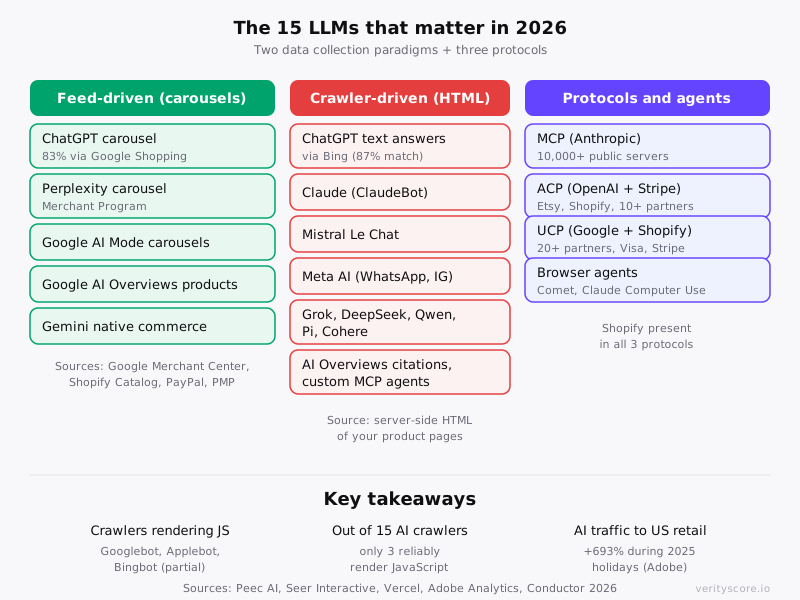
Main feed-driven surfaces:
- ChatGPT carousel: 83% of products come from Google Shopping (Peec AI study)
- Perplexity carousel: direct feed via Perplexity Merchant Program + Shopify Catalog + PayPal
- Google Shopping: Google Merchant Center
- Google AI Mode carousels: Merchant Center + UCP
- Google AI Overviews products: Merchant Center
- Gemini native commerce: UCP flag
Paradigm 2: crawler-driven (text answers, citations)
Conversational answers, citations, non-carousel recommendations rely on HTML crawling. This is where the majority of LLMs operate.
Main crawler-driven surfaces:
- ChatGPT text answers: Bing crawl + GPTBot/OAI-SearchBot
- ChatGPT citations: Bing crawl (87% of citations)
- Perplexity text answers: PerplexityBot on HTML
- Claude: ClaudeBot, Claude-User, Claude-SearchBot
- Mistral Le Chat: MistralAI-User
- Meta AI: Meta-ExternalAgent
- Grok, DeepSeek, Qwen, Pi, Cohere: proprietary crawlers
- Google AI Overviews citations: Googlebot
Paradigm 3: agents and protocols
New channels emerged in 2025-2026. They rely on standard protocols.
- MCP (Model Context Protocol): 10,000+ active public MCP servers in March 2026, 97 million monthly SDK downloads, donated by Anthropic to the Agentic AI Foundation (Linux Foundation) with Block, OpenAI, Google, Microsoft, AWS, Cloudflare
- ACP (Agentic Commerce Protocol): OpenAI + Stripe, Apache 2.0, date-based versioning, REST or MCP interface, 10+ live partners (Etsy, Shopify, Target, Sephora, Nordstrom, Lowe’s, Best Buy, Home Depot, Wayfair)
- UCP (Universal Commerce Protocol): Google + Shopify, launched January 2026, 20+ partners (Adyen, American Express, Best Buy, Flipkart, Macy’s, Mastercard, Stripe, Home Depot, Visa, Zalando, Target, Walmart, Etsy, Wayfair, PayPal)
- Browser agents: Perplexity Comet, Claude Computer Use, OpenAI Operator/ChatGPT Agent, Browser Use (open source)
Shopify is present in all three protocols, which explains how Agentic Storefronts (March 2026) simultaneously feed ChatGPT, Copilot, Gemini, AI Mode, Perplexity.
AI crawlers and JavaScript rendering matrix
| Bot | Operator | User-Agent | JS? | robots.txt |
|---|---|---|---|---|
| GPTBot | OpenAI | GPTBot/1.1; +https://openai.com/gptbot | No | Yes |
| OAI-SearchBot | OpenAI | OAI-SearchBot | No | Yes |
| ChatGPT-User | OpenAI | ChatGPT-User | No | Yes |
| ClaudeBot | Anthropic | ClaudeBot | No | Yes |
| Claude-User | Anthropic | Claude-User | No | Yes |
| Claude-SearchBot | Anthropic | Claude-SearchBot | No | Yes |
| PerplexityBot | Perplexity | PerplexityBot/1.0 | No | Yes |
| Perplexity-User | Perplexity | Perplexity-User | No | No |
| MistralAI-User | Mistral | MistralAI-User/1.0 | Browser session | No |
| Googlebot | Googlebot/2.1 | Yes | Yes | |
| Google-Extended | Google-Extended | N/A (uses Googlebot) | Yes | |
| Bingbot | Microsoft | bingbot/2.0 | Yes, partial | Yes |
| Applebot / Applebot-Extended | Apple | Applebot | Yes | Yes |
| Meta-ExternalAgent | Meta | meta-externalagent/1.1 | No | Yes |
| CCBot | Common Crawl | CCBot/2.0 | No | Yes |
Conclusion: of 15 major crawlers, only 3 reliably render JavaScript (Googlebot, Applebot, Bingbot with limits). For the other 12, server-side HTML is the only source.
Prioritization for a Shopify merchant
For an e-commerce merchant aiming to maximize AI visibility in 2026, here is the recommended priority order (by decreasing impact):
- Google AI Overviews + AI Mode (2 billion monthly users, 75M DAU) : depends on Google Search + Merchant Center. Action: complete schema.org Product + Merchant Center feed + allow Google-Extended
- ChatGPT Shopping (900M weekly users, 83% of carousel from Google Shopping) : both GMC feed and HTML quality count
- Perplexity Shopping (100M+ MAU, 4.4x higher conversion per Conductor 2026) : free Merchant Program + native Shopify Catalog + quality HTML
- Claude and MCP agents : purely HTML. Action: complete JSON-LD, robots.txt open to ClaudeBot
- Mistral Le Chat (priority for French-speaking audience) : HTML crawl via MistralAI-User. Action: clean HTML, no blocking
- Meta AI (massive WhatsApp/Instagram distribution) : HTML via Meta-ExternalAgent
- Gemini app : covered by Google optimization
- Grok, Bing Copilot : covered by HTML + Bing (Bingbot crawl)
- Browser agents (Comet, Claude Computer Use, Browser Use) : depend on live HTML
2026 AI commerce market data
Key numbers to make the case for GEO investment to a product committee or leadership:
- +693% AI traffic to US retail sites during 2025 holidays (Adobe Analytics NRF 2026)
- AI traffic converts 31% higher than other sources, bounce rate -27% (Adobe)
- +254% RPV (revenue per visitor) from AI traffic during holidays (Adobe)
- 4.4x conversion for AI traffic vs traditional organic per Conductor 2026 (13,770 domains sample)
- 91% of ecommerce queries now trigger an AI-generated result (Conductor)
- Amazon Rufus (now Alexa for Shopping): 300 million users, 12 billion incremental sales 2025, +60% purchase likelihood when engaged
- Agentic commerce market: 1.5 to 5 trillion dollars by 2030 per McKinsey, Bain, Juniper Research
Related articles
- AggregateRating invisible to AI: technical guide
- Schema.org Product on Shopify
- Sell on ChatGPT: Shopify guide 2026
- Perplexity Shopping: merchant guide
- ACP: Agentic Commerce Protocol
- UCP: Universal Commerce Protocol
- robots.txt and AI crawlers