# Shopify agents.md: UCP for AI Commerce
> Shopify now natively serves agents.md, llms.txt and llms-full.txt on many stores. The real signal: UCP, MCP, catalog, cart and checkout become the AI visibility infrastructure.
- Canonical HTML: https://verityscore.io/en/blog/shopify-agents-md-llms-txt-ucp-ai-commerce/
- Markdown alternate: https://verityscore.io/en/blog/shopify-agents-md-llms-txt-ucp-ai-commerce.md
- Language: en
- Content type: blog
- Published: 2026-05-23
- Updated: 2026-05-30
- Tags: shopify, agents-md, llms-txt, ucp, mcp, agentic-commerce, geo
Since early May 2026, many Shopify stores, especially on the Plus plan, expose an `/agents.md` file, referenced in the sitemap and wired to UCP/MCP. This is not just a story about a text file. It is the shift from "the AI reads my site" to "the agent can interact with my commerce."
> **Update May 29, 2026**. Several facts have sharpened and corrected the picture since publication. (1) Agentic Storefronts have been enabled by default for eligible US merchants since March 24, 2026, regardless of plan (not Plus-gated); Shopify also announced an Agentic plan that opens its Catalog to brands not using Shopify as their storefront. (2) Google launched **Universal Cart on May 19 at Google I/O** with Nike, Sephora, Target, Ulta Beauty, Walmart, Wayfair, **Fenty Beauty and Steve Madden** (Shopify) as US launch partners. (3) On **May 20 at Google Marketing Live**, Google detailed UCP's expansion (new countries, new verticals such as hotels and food delivery); AP2, the agent payments protocol distinct from UCP, was handed to the FIDO Alliance for governance. (4) The **Supplemental Terms for Agentic Storefronts have been effective since May 25** for eligible merchants (Shopify email sent May 12). (5) Shopify **officially documented `templates/agents.md.liquid`, `llms.txt.liquid` and `llms-full.txt.liquid` on May 28** (changelog). (6) As of May 29, **all six stores we tested, including Gymshark which returned 404 on May 23, now serve `/agents.md` and `/.well-known/ucp`**. Sources: shopify.com/news, Google blog May 19-20, Adweek May 20, Craftshift May 12, Shopify changelog May 28, Verity Score tests May 29.
> **Market availability — non-US merchants, as of May 29, 2026**. Direct in-chat checkout via **Google AI Mode, Gemini app, Microsoft Copilot and ChatGPT Agentic Storefronts started in the US and is not yet open to all stores**: the official Shopify Help Center states it is not yet available to all merchants, and Google announces expansion to Canada and Australia (UK next). The strict "US-to-US only" phrasing is not confirmed by the cited Shopify page. A non-US merchant can enable Agentic Storefronts by configuring a US market in `Settings > Markets` with US shipping rates, but native in-chat checkout is not yet available to non-US shoppers. For non-US markets today, the lever is **discoverability** (the agent finds the product and redirects the shopper to the storefront to buy), not in-chat checkout.
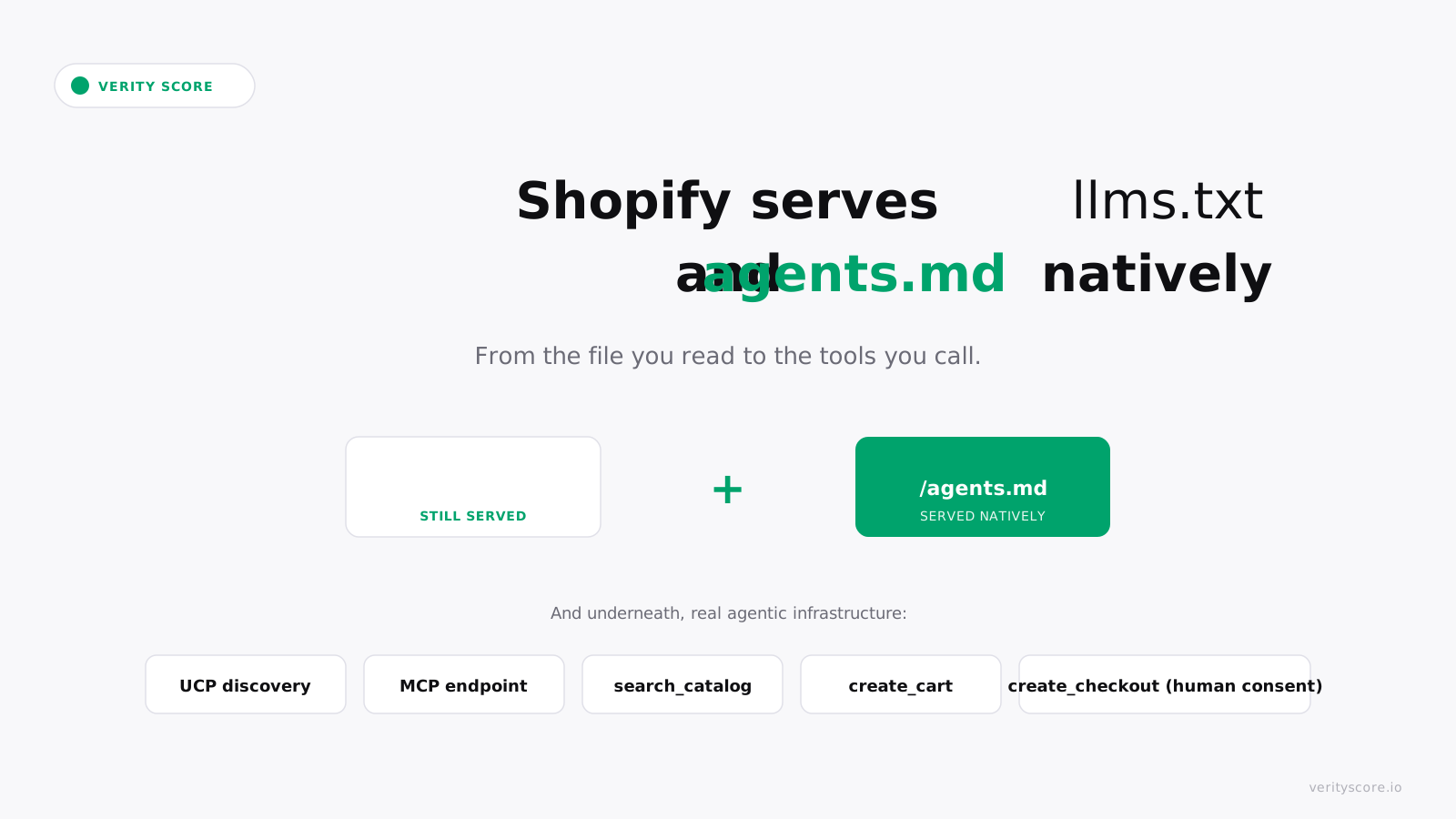
Figure 1: agents.md as the new agentic entry point for Shopify stores. Sources: Verity Score tests, Shopify.dev, Shopify Engineering, Google, May 2026.
The rollout was publicly spotted by Anton Ekström in early May 2026 and covered by Shopifreaks on May 7, 2026. It shows up within minutes of testing: many Shopify stores now natively serve three distinct files, `/llms.txt`, `/llms-full.txt` and `/agents.md` (different content), and the older proxy or admin redirect methods become difficult to maintain. Watch out for a common misconception: `/llms.txt` does not redirect to `/agents.md`. On the stores we tested, the only 301 observed is the non-www to www normalization, not an llms-to-agents redirect.
The immediate reflex is to read this as a technical SEO problem: "Shopify is blocking custom llms.txt files." That is part of it, but not the most important part.
The real signal runs deeper. Shopify is not just replacing one file with another. Shopify is moving the interface between merchants and AI agents.
`llms.txt` essentially said: here is how to understand my site.
`agents.md` says something else: here is how to search my catalog, build a cart, start a checkout, apply fulfillment rules and respect payment approval.
This is no longer just about discoverability. This is commerce infrastructure.
## What we tested
On May 22 and 23, 2026, we tested several public Shopify stores.
On Allbirds:
- `https://www.allbirds.com/llms.txt` answers with a `301`
- `https://www.allbirds.com/llms-full.txt` also answers with a `301`
- `https://www.allbirds.com/agents.md` answers with a `200`, with `Content-Type: text/markdown`
- `https://www.allbirds.com/.well-known/ucp` answers with a `200`, returning a UCP discovery JSON
- the main sitemap references a `sitemap_agentic_discovery.xml` file
- this agentic sitemap contains a single URL: `/agents.md`
Same behavior observed on Kylie Cosmetics, ColourPop, Steve Madden and Fenty Beauty. On ColourPop and Steve Madden, the `Location` header of the 301 on `/llms.txt` explicitly points to `/agents.md`. On Fenty Beauty, we also see a canonicalization 301 from `www.fentybeauty.com` to `fentybeauty.com`, which shows that routing details vary store by store.
Important caveat: **the rollout is not universal yet, but it is spreading fast**. On May 23, 2026, Gymshark still returned 404 on `/llms.txt`, `/agents.md` and `/.well-known/ucp`; as of May 29 it serves all three. Propagation is gradual, store by store, and smaller stores or those on custom themes have not received it yet.
And we need to correct an overly absolute phrasing that is circulating: Shopify does not "redirect" `/llms.txt` to `/agents.md`. On the stores we tested, both files, plus `/llms-full.txt`, are served natively with distinct content, and the only 301 is the non-www to www normalization. There is no official announcement of an llms-to-agents redirect.
The most accurate framing is this: **Shopify appears to have introduced native routes for `/llms.txt`, `/llms-full.txt`, `/agents.md`, `/.well-known/ucp`, `/api/ucp/mcp` and an agentic sitemap, with a default behavior that favors `/agents.md` as the agent-facing document.**
## What agents.md actually contains
The `/agents.md` file generated on the tested stores follows a fairly stable structure.
It starts with a custom title, for example:
`# Agent Instructions - Allbirds`
Then it describes how an AI agent can interact with the store. The document does not just list important pages. It outlines a complete journey:
- store discovery via `/.well-known/ucp`
- MCP endpoint via `/api/ucp/mcp`
- catalog search
- cart creation
- checkout creation
- fulfillment update
- checkout finalization with human approval
- access to store policies and metadata
It also instructs buyer agents to favor Shopify's Shop skill to handle search, pricing, discounts, checkout via Shop Pay and order tracking.
This detail is strategic. Shopify does not just let agents read stores. Shopify steers agents toward its native rails: Shop, Shop Pay, UCP, MCP, Shopify Catalog, checkout.
## The real machine-readable file is not agents.md
`/agents.md` is readable by a human or by an agent. But the real technical contract lies elsewhere.
On Allbirds, `/.well-known/ucp` returns a JSON declaring:
- the supported UCP version (`2026-04-08`)
- the previous supported versions (`2026-01-23`)
- the `dev.ucp.shopping` service
- the MCP transport
- the `/api/ucp/mcp` endpoint
- the supported capabilities: catalog (search, lookup), cart, checkout, order, fulfillment, payments (the UCP profile also declares payment handlers)
- the available payment handlers, including Google Pay and Shopify card
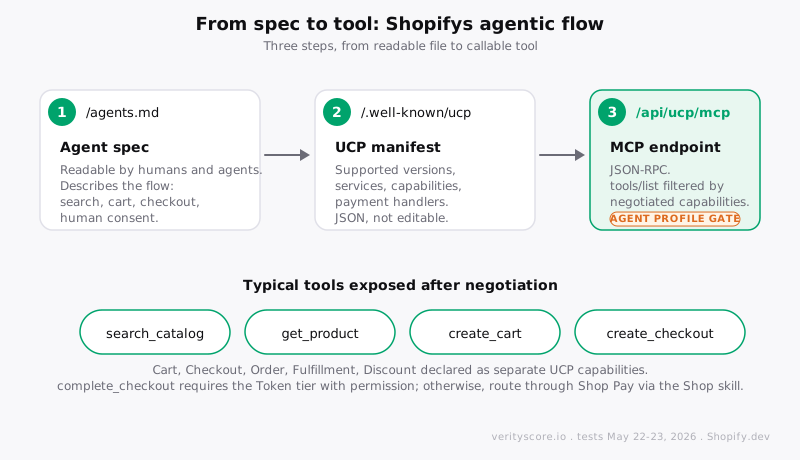
In other words, `/agents.md` plays the role of a user manual. `/.well-known/ucp` plays the role of a capabilities manifest. `/api/ucp/mcp` plays the role of an actionable interface.
This is exactly the movement Shopify describes in its agentic commerce documentation: MCP tools implement UCP at every stage of the buyer journey, from product discovery to checkout and order tracking.
## The silent migration from /api/mcp to /api/ucp/mcp
One often-overlooked technical point: on April 22, 2026, Shopify migrated its storefront MCP endpoint from `/api/mcp` to `/api/ucp/mcp`, and tool names changed (`search` became `search_catalog`, `lookup` became `lookup_catalog`).
The official Shopify Dev changelog and the Weaverse migration guide (Hydrogen) confirm **two distinct dates**, not one:
| Date | What changes |
|---|---|
| **May 30, 2026** | UCP becomes the **effective API version** of the Storefront Catalog MCP tools. The old endpoint and tool names still respond, but the docs and new clients point to the new version. |
| **June 15, 2026** | The **old `/api/mcp` endpoint** and the **old tool names** (`search`, `lookup`) are **fully removed**. Any integration still calling the old URL stops working. |
Concrete implication for Hydrogen developers, custom MCPs, or apps already integrated with the old endpoint: migration to `/api/ucp/mcp` must be **completed before June 15, 2026**, ideally before May 30 to get a clean test window on the new version. Check code and app manifests for any call to `/api/mcp` or any unsuffixed tool name.
Important note: `/api/mcp` (old) and `/api/ucp/mcp` (new) are not redundant. According to the Shopify docs, the `/api/mcp` endpoint remains in use for non-UCP tools (`get_cart`, `update_cart`, `search_shop_policies_and_faqs`); only the catalog tools (`search_catalog`, `lookup_catalog`, `get_product`) move to `/api/ucp/mcp`. This separation is documented at `shopify.dev/docs/apps/build/storefront-mcp/servers/storefront`.
## What the MCP endpoint exposes, and how it filters agents
First important point, verified by direct curl on May 23, 2026. The `/api/ucp/mcp` endpoint does not expose its tools to anyone. A `tools/list` JSON-RPC without an agent profile immediately returns:
```json
{
"jsonrpc": "2.0",
"id": 1,
"error": {
"code": -32001,
"message": "UCP discovery failed",
"data": {
"code": "invalid_profile_url",
"content": "Unable to fetch agent profile: Missing profile uri"
}
}
}
```
To discover the tools, the agent must pass a UCP agent profile URI in `meta.ucp-agent.profile`. Shopify fetches this profile, validates its signature and cache-control, computes the intersection with the store's capabilities, and only exposes the tools that both sides can negotiate. This is documented at `shopify.dev/docs/agents/profiles`.
Three identification tiers, with different rate limits and tools depending on the tier:
| Tier | Catalog | Cart | Checkout | `complete_checkout` | Order |
|---|---|---|---|---|---|
| Token (JWT Dev Dashboard) | yes | yes | yes | yes if authorized | yes with orders scope |
| Signed (HTTP signatures RFC 9421, ECDSA P-256) | yes | yes | yes | no | no |
| Anonymous | yes | yes | yes (build/edit) | no | no |
On the tooling side, Shopify publicly documents several UCP-compliant MCP servers. All are exposed by the same `/api/ucp/mcp` endpoint but activated by the capabilities the agent advertises in its profile:
| UCP capability | Documented MCP tools |
|---|---|
| `dev.shopify.catalog` (Storefront Catalog MCP) | `search_catalog`, `lookup_catalog`, `get_product` |
| `dev.shopify.catalog.global` (Global Catalog MCP) | cross-merchant search over all Shopify listings |
| `dev.ucp.shopping.cart` (Cart MCP) | cart building and iteration, line items, buyer context |
| `dev.ucp.shopping.checkout` (Checkout MCP) | cart to checkout conversion, finalization by trusted agent |
| `dev.ucp.shopping.order` (Order MCP) | `get_order` for on-demand reads, complemented by order webhooks |
| `dev.ucp.shopping.fulfillment` / `discount` / `buyer_consent` | extensions that graft onto checkout and cart |
Three important clarifications:
- Only the three Storefront Catalog tools (`search_catalog`, `lookup_catalog`, `get_product`) are explicitly named in the Shopify catalog docs. The exact names of the Cart, Checkout and Order tools are not enumerated in the same format. The other precise tools/list entries depend on negotiation and the auth tier.
- `complete_checkout` requires the Token tier with permission, never anonymous. Agents that want to complete the transaction go through Shop Pay via the Shop skill `https://shop.app/SKILL.md` (which is exactly what `/agents.md` recommends to buyer agents).
- The Cart MCP is less restricted than the Checkout MCP. Shopify pushes agents to iterate in the cart (line items, totals, context) and only convert to checkout when the buyer is ready to purchase.
Once again, the nuance is essential. An SEO crawler reads a page. A commerce agent can call a tool, provided it has an identity and an intent the store accepts.
And the tool does not work with HTML. It works with objects: variant ID, prices in minor units, country, currency, language, purchase intent, availability, discounts, fulfillment, payment.
The new storefront is no longer just the product page. It is the quality of the data model exposed to agents, and the store's ability to negotiate with every agent that knocks on the door.
Figure 2: from /agents.md to MCP tools, the real path of the buyer agent. The agent profile gate on /api/ucp/mcp filters tools based on negotiated capabilities. Sources: Verity Score tests May 22-23, 2026, Shopify.dev.
## Why Shopify is doing this now
Context matters.
On January 11, 2026, at the National Retail Federation (NRF), Shopify and Google jointly announced the Universal Commerce Protocol. The stated goal: enable AI agents to connect and transact with any merchant. UCP is announced as open-source, co-developed with Shopify, Etsy, Wayfair, Target and Walmart, and endorsed by more than twenty partners (Adyen, Amex, Best Buy, Mastercard, Stripe, Visa, Zalando, etc.).
In the same move, Shopify documents its MCP servers for agents:
- Global Catalog, to search across Shopify listings at scale
- Storefront Catalog, to search the catalog of a specific merchant
- Cart MCP, to build and update carts
- Checkout, to convert a cart into a checkout and, depending on the agent's trust level, take the buyer journey further
- Order MCP and webhooks, to track post-purchase state
Google is pushing UCP into Search, Gemini and Google Pay in parallel. On **May 19 and 20, 2026**, at Google I/O and then at Google Marketing Live, Google announced:
- the Universal Cart, a cross-merchant cart integrated into Search, Gemini, YouTube and Gmail
- UCP expansion to new countries (Canada, Australia, United Kingdom)
- extension to new verticals (hospitality, food delivery)
- Affirm and Klarna as buy-now-pay-later options embedded in Google Pay
- an AI performance insights tool in Merchant Center
- Ask Advisor, a Gemini cross-product agent
The message is very clear: agentic purchasing becomes a Google surface, not just a Shopify experiment.
Three additional precisions dated May 18-20, 2026 confirm the move:
- **Merchant access**: Agentic Storefronts have been enabled by default for eligible US merchants since March 24, 2026, regardless of plan (not Plus-only). Shopify also announced an Agentic plan that opens its Catalog to brands not using Shopify as their storefront. The agent can search products, build carts and complete a checkout via a single UCP skill (source: shopify.com/news/ai-commerce-at-scale).
- **May 20**: at Google Marketing Live, Google detailed UCP's expansion to new countries and new verticals (hotels, food delivery). The agent payments protocol AP2, distinct from UCP, was handed to the FIDO Alliance for governance (sources: Google blog May 20, ppc.land).
- **Shopping Graph**: Google now claims **60 billion listings**, up from earlier, more cautious figures. The product reservoir behind Universal Cart and AI Mode shopping is deeper than previously assumed.
Also on the Shopify side: since around May 14-15, **Agentic Storefronts has its own dedicated admin section**, promoted from a sub-tab under "Sales channels" to a top-level tier. The internal data-quality dashboard (queries that rank, products with issues) is now directly visible to merchants, which brings the GEO audit closer to a Search Console audit.
In this context, `/agents.md` becomes the visible brick of a broader shift: Shopify is preparing its merchants to be discovered, queried and potentially transacted with by agents.
## llms.txt vs agents.md: the fundamental difference
`llms.txt` was born as a simple proposal: provide LLMs with a readable map of the site, important content, reading rules, sometimes a concentrated Markdown version of the documentation or key pages.
It is useful. But it is still a documentary logic.
`agents.md` at Shopify changes the grammar:
| Dimension | llms.txt | agents.md Shopify |
|---|---|---|
| Nature | reading manifest | agentic interaction manual |
| Goal | help an LLM understand the site | help an agent act in commerce |
| Main data | URLs, descriptions, important pages | endpoints, capabilities, tools, rules |
| Action level | reading | search, cart, checkout, order |
| Center of gravity | content | catalog + protocol + transaction |
| Main risk | incomplete or unmaintained content | inconsistent product data, prices, stock or policies |
Plainly put: `llms.txt` helps the AI read. `agents.md` helps the agent buy.
## What this changes for Shopify merchants
The first consequence is practical. If you had a `/llms.txt` generated by an app, proxy or URL redirect, you need to check what is actually being served today.
On the Shopify Developer Community forum and several guides published in May 2026 (Craftshift, DEV community / no7software, n1n.ai, Honeybound), it is documented that:
- older admin redirects to a custom `llms.txt` are no longer honored once Shopify serves the route natively
- `templates/llms.txt.liquid` now lets you override the generated content, on the same pattern as `robots.txt.liquid`
- `templates/agents.md.liquid` is officially documented by Shopify as of the May 28, 2026 changelog, alongside `templates/llms.txt.liquid` and `templates/llms-full.txt.liquid`. It controls the served `/agents.md` and the default fallback, on the same pattern as `robots.txt.liquid`
- `/.well-known/ucp` is generated by Shopify from the store configuration and is not overridable, which is consistent with its role as a truth manifest
The second consequence is strategic. Installing an `llms.txt` is no longer enough to claim an AI commerce strategy. The subject becomes:
- are products clearly named and categorized?
- are variants clean and exploitable by `search_catalog`?
- are prices and availability consistent across Shopify, the Merchant Center feed, the schema and the storefront?
- do images have `alt_text` usable by an agent presenting the product?
- are reviews structured?
- are claims provable and traceable?
- are shipping and return policies readable and reachable from the canonical URL?
- do product pages answer concrete intents ("breathable for summer", "compatible with sensitive skin", "two-year warranty")?
- can the catalog be queried by an agent with country, language, currency and intent context?
The center of gravity moves: from the file to the catalog.
## The risk: believing that Shopify has solved it all
Shopify makes the infrastructure accessible. It does not guarantee visibility.
This is probably the main trap for merchants. Seeing `/agents.md`, `/.well-known/ucp` and `/api/ucp/mcp` in place can give the impression that the store is ready for AI commerce.
In reality, Shopify provides the route. The quality of what flows through that route still depends on the merchant.
An agent searching for "breathable sneakers to walk all day in summer" is not going to recommend a product because `/agents.md` exists. It will depend on concrete signals:
- product title
- usable description
- material attributes
- usage
- season
- availability
- price
- customer reviews
- return policy
- comfort proof
- consistency between product page, schema.org, Merchant Center feed and Shopify data
Agentic infrastructure amplifies the data. It does not magically fix it.
## The subject is not just Shopify
What Shopify is doing with `/agents.md` is part of a broader battle to control the rails of agentic purchasing.
- OpenAI and Stripe pushed the Agentic Commerce Protocol (ACP) around conversational checkout.
- Google and Shopify push UCP around a broader agentic commerce standard.
- Google also formalized the Agent Payments Protocol (AP2), grouped with UCP in its Marketing Live announcement on May 20, 2026: AP2 authorizes payments made by agents on behalf of a user, with signed digital mandates and a verifiable chain of responsibility. First arrivals in Gemini Spark expected in the coming months.
- Anthropic popularized MCP as the connection protocol between models and tools. UCP is explicitly compatible with MCP, A2A and AP2 according to the Google docs.
Microsoft, Google, OpenAI and Anthropic all converge on the same intuition: AI will not just answer. It will act.
For e-commerce, this means the web page becomes one surface among others.
The customer can still land on your site. But they can also:
- ask a question in ChatGPT
- compare in Gemini
- add a product from Google AI Mode
- buy via Universal Cart
- go through Shop Pay
- ask a personal agent to track an order
In this world, the challenge is no longer just to rank. It is to be available as an actionable option.
## What to audit this week
### 0. Verify Agentic Storefronts eligibility (4 criteria)
Before auditing endpoints, open `Shopify Admin > Settings > Apps and sales channels > Agentic` (or `/apps/agentic`). Access is in early access and rolled out store by store: Shopify notifies you by email and in the admin when it becomes available. If the screen says "Agentic storefronts aren't available", either your store is not yet in the rollout wave, or one of the 4 prerequisites below is unmet (conditions synthesized from the Shopify Catalog, Supplemental Terms and Policies pages, not a single official list on one page):
1. The store sells to US customers (US market active in `Settings > Markets`, US shipping rates configured). The store itself can be based anywhere.
2. Products eligible for Shopify Catalog (standardized category, image, price with currency, published to Online Store / Hydrogen / Headless).
3. The **Supplemental Terms for Agentic Storefronts** are accepted. These terms have been **effective since May 25, 2026** for all eligible merchants, following the email Shopify sent on May 12, 2026.
4. The 3 policy pages are filled in (`Settings > Policies`): Terms of service, Privacy policy, Return and refund policy.
For the full breakdown with admin paths, see our dedicated KB: [Shopify Agentic Storefronts: the 4 official eligibility criteria](https://verityscore.io/en/kb/shopify-agentic-storefronts-eligibility/).
### 1. Verify the endpoints actually being served
Test:
- `/llms.txt`
- `/llms-full.txt`
- `/agents.md`
- `/.well-known/ucp`
- `/api/ucp/mcp`
- `/sitemap.xml`
- `/sitemap_agentic_discovery.xml`
Look at HTTP statuses, redirects, `Content-Type` headers and the final content. Do not rely on what is configured in the admin: check what the agent actually sees. And if your endpoints 404 this month, that is not abnormal: the rollout is store-by-store.
### 2. Check whether Shopify overwrote your custom llms.txt
If you previously hosted a custom `llms.txt` via Cloudflare Worker, Shopify URL Redirect, or a third-party app, there is a real risk that it was silently replaced by the Shopify default during the April-May 2026 rollout. Several cases reported on the Shopify developer forum confirm this silent replacement. Compare what is served today to what you expect. If there is a divergence, rebuild via `templates/llms.txt.liquid`.
### 3. Read your agents.md as a buyer agent
Does your `/agents.md` contain the correct brand name? The right policies? The right canonical domain? The right endpoints? Is the tone purely generic or does it carry useful information about your commerce?
Even though Shopify generates part of the file, you need to know what it says on your behalf. Use the override via `templates/agents.md.liquid` (officially supported since May 28, 2026) to specify rules unique to your catalog (B2B gating, age verification, veterinary constraints, single-market, etc.).
### 4. Audit the /api/mcp to /api/ucp/mcp migration
If you have a Hydrogen integration, a custom agent, or an app consuming the historical `/api/mcp`: verify the URL and the tool names in use (`search` vs `search_catalog`, `lookup` vs `lookup_catalog`). Two pivot dates already covered above: **May 30, 2026** (UCP becomes effective version) and **June 15, 2026** (final removal of the old endpoint for catalog tools). Migrate before June 15 to avoid a silent break, ideally before May 30 to get a clean test window on the new version.
### 5. Test catalog search
The real test is not "does the endpoint exist?". The real test is: "what does the catalog return when an agent searches the way a human would?"
Examples:
- "skincare gift under 40 dollars for sensitive skin"
- "shoes to walk 10 km a day in summer"
- "black wedding-guest dress, not too formal"
- "sugar-free vegan-friendly supplement"
If the results are poor, the problem is not MCP. The problem is the product data.
### 6. Compare with Merchant Center and schema.org
Agents do not have a single source. They cross-reference signals: Shopify Catalog, Merchant Center, schema.org, product pages, reviews, editorial content, policies, the open web.
If the price differs between your page, your feed and your exposed data, the agent hesitates. If your availability is inconsistent, it avoids you. If your claims are not proven, it ignores them.
### 7. Keep llms.txt, but do not overrate it
A clean `llms.txt` can still be useful to clarify the site, key pages, guides, policies and reference content. But on Shopify, it should not be treated as the center of the AI strategy.
The 2026 priority is rather:
- structured catalog
- complete product attributes
- clean schema.org
- consistent Merchant Center feed
- extractable guide and FAQ pages
- proven claims
- tested agentic endpoints
## Summary table
| Observed signal | What it means | What to do |
|---|---|---|
| `/llms.txt`, `/llms-full.txt` and `/agents.md` served natively (distinct files, no llms-to-agents redirect) | Shopify exposes the agent-facing document on top of llms.txt | check the final served content |
| `/agents.md` exists | the store exposes an agentic interaction manual | read what Shopify says to agents |
| `/.well-known/ucp` exists | the store declares its UCP capabilities | check versions, endpoints, payment handlers |
| `/api/ucp/mcp` exposes tools | the agent can query catalog, cart, checkout | test catalog tools read-only, migrate from `/api/mcp` |
| `sitemap_agentic_discovery.xml` is in the sitemap | Shopify makes `/agents.md` discoverable | check indexation and canonicalization |
| 404 endpoints on your store | rollout has not propagated yet | retest periodically, contact support if stuck |
| Former app proxy `llms.txt` no longer works | the native route took priority, the custom one may have been overwritten | test a Liquid override if needed |
## What Verity Score will now check
For a Shopify AI commerce audit, only checking `robots.txt`, `sitemap.xml` and schema.org is no longer enough.
You have to add an agentic layer:
- presence and status of `/agents.md`
- content and consistency of `/agents.md` (canonical, policies, brand name)
- presence of `/.well-known/ucp`
- supported UCP version and fallback versions
- declared services and capabilities
- presence of the MCP transport
- behavior of the `/api/ucp/mcp` endpoint (response to the agent profile gate, correct rejection of missing or malformed profiles)
- traceable `/api/mcp` to `/api/ucp/mcp` migration on the store side
- quality of `search_catalog` responses on real intents with a test agent profile
- price/stock consistency between MCP, product page, schema.org and Merchant Center
- variant attribute quality
- presence of policies in agentic sources
- proof signals around product claims
E-commerce GEO becomes a hybrid discipline: technical SEO, product data, commerce protocol, trust and conversion.
## Takeaways
The debate "is `llms.txt` being replaced?" is useful, but it can make you miss the real movement.
Shopify is not just trying to help LLMs read stores. Shopify is preparing stores to be used by buyer agents.
The difference is major.
In the first world, the brand optimizes pages to be cited.
In the second, it optimizes a catalog, attributes, pricing rules, policies and checkout rails to be selected and bought.
The `/agents.md` file is visible. But the real work happens underneath: UCP, MCP, catalog search, cart, checkout, payment handlers, Merchant Center, schema.org, product data.
For merchants, the right question is therefore not: "Do I have an llms.txt?"
The right question is: **if a buyer agent queries my store tomorrow morning, does it have enough trustworthy data to recommend me over a competitor?**
---
*An article by Kamil Kaderbay. To audit how ready a Shopify store is for AI commerce, see [Verity Score](https://verityscore.io).*
## FAQ
### Did Shopify officially announce the replacement of llms.txt by agents.md?
No official statement framed it that way. The behavior is observable on many major Shopify stores, and the Shopify developer forums have been discussing native /llms.txt, /llms-full.txt and /agents.md routes since early May 2026. The rollout is publicly documented by the community (Anton Ekström, Shopifreaks, Craftshift, DEV community, n1n.ai, Honeybound) but not by a Shopify press release.
### Is the rollout live on all Shopify stores?
Propagation is moving fast. As of May 29, 2026, Allbirds, Kylie Cosmetics, ColourPop, Steve Madden, Fenty Beauty AND Gymshark all serve /agents.md and /.well-known/ucp (Gymshark still returned 404 on May 23). The rollout happens store by store and is not universal yet, but it is spreading quickly and is not limited to Shopify Plus.
### Can you still customize llms.txt on Shopify?
Yes, via templates/llms.txt.liquid. Shopify officially documented it on May 28, 2026 (changelog: customize llms.txt, llms-full.txt and agents.md): this template overrides the generated default, on the same pattern as robots.txt.liquid. Older admin URL redirects are no longer reliable once the native route is active.
### Can you customize agents.md?
Yes. As of the Shopify changelog dated May 28, 2026, templates/agents.md.liquid is officially documented, alongside templates/llms.txt.liquid and templates/llms-full.txt.liquid. It controls the served /agents.md file and the default fallback, on the same pattern as robots.txt.liquid.
### Does agents.md automatically improve visibility in ChatGPT or Gemini?
No. It makes the store more readable and actionable for compatible agents, but visibility still depends on the quality of product data, trust signals, availability, prices, reviews, pages and the integrations of the AI platforms themselves.
### How is it different from schema.org?
schema.org describes entities on your pages: Product, Offer, AggregateRating, FAQ, Organization. UCP/MCP exposes actionable capabilities: search, fetch a product, create a cart, create a checkout. The two layers are complementary.
### Should I delete my llms.txt?
No. But stop treating it as a GEO talisman. Keep it useful, clean, sober. Then focus the effort on the catalog, attributes, proof, feeds and agentic endpoints.
### My llms.txt was custom and it changed by itself, is that normal?
Yes, it is a case documented by the Shopify community. Configs via Shopify URL Redirect, Cloudflare Worker or third-party app may have been silently replaced by the Shopify default during the rollout. Solution: rebuild the desired version via templates/llms.txt.liquid.
### Why does my curl on /api/ucp/mcp return a 'UCP discovery failed' error?
Expected behavior. Shopify requires each MCP request to carry meta.ucp-agent.profile pointing to a UCP agent profile JSON hosted at a public URL. Without a profile, or with a malformed one (invalid cache-control, unknown version, empty capabilities), the endpoint returns a JSON-RPC error code -32001. To test, the agent must host its own profile or use one of the Shopify fixtures documented at shopify.dev/docs/agents/profiles. Three auth tiers (Token, Signed, Anonymous) then grant different access and rate limits.
### What is the real deadline to migrate from /api/mcp to /api/ucp/mcp?
There are two distinct dates, often confused. On May 30, 2026, UCP becomes the effective API version: docs and new clients point to /api/ucp/mcp, but the old endpoint still responds. On June 15, 2026, the old /api/mcp endpoint and the old tool names (search, lookup) are fully removed for catalog tools. The operational deadline is therefore June 15, but migrating before May 30 leaves a clean production test window on the new version. Source: Shopify dev changelog and Weaverse migration guide (April 24, 2026).
### Does Google Universal Cart affect Shopify merchants?
Yes, directly. Google launched Universal Cart on May 19, 2026 at I/O. Launch partners include Nike, Sephora, Target, Ulta Beauty, Walmart, Wayfair, plus Fenty Beauty and Steve Madden, which are Shopify stores. The mechanic: the shopper adds products from Search, Gemini, YouTube or Gmail, and the cross-merchant cart handles checkout through Google Pay (with Affirm and Klarna embedded as BNPL). For a US-based Shopify merchant that has enabled Agentic Storefronts, this is a new sales channel without additional integration work. For non-US merchants, in-chat checkout is not yet available; international rollout is underway (Canada and Australia announced, UK next) with no firm date. Until then, the lever remains discoverability.
### Is UCP limited to Shopify Plus merchants?
No. Agentic Storefronts have been enabled by default for eligible US merchants since March 24, 2026, regardless of plan (not Plus-only). Shopify also announced an Agentic plan that opens its Catalog even to brands not using Shopify as their storefront. The base capabilities (search products, build a cart, complete a checkout) are not gated to the Plus plan. Source: shopify.com/news/ai-commerce-at-scale. Some advanced features (saved catalogs, custom access scopes) may remain Plus-only.
## Sources
- [Shopify.dev: Agentic commerce with UCP](https://shopify.dev/docs/agents) (official)
- [Shopify.dev: Storefront Catalog MCP](https://shopify.dev/docs/agents/catalog/storefront-catalog) (official)
- [Shopify.dev: Agent profiles and UCP negotiation](https://shopify.dev/docs/agents/profiles) (official)
- [Shopify.dev: Auth and rate limiting (Token, Signed, Anonymous)](https://shopify.dev/docs/agents/profiles/auth-and-rate-limiting) (official)
- [Shopify Engineering: Building the Universal Commerce Protocol](https://shopify.engineering/UCP) (official)
- [Shopify News: The agentic commerce platform (January 11, 2026)](https://www.shopify.com/news/ai-commerce-at-scale) (official)
- [UCP specification](https://ucp.dev) (official)
- [Shopify Developer Community: Llms.txt and agents.md thread](https://community.shopify.dev/t/llms-txt-and-agents-md/34049) (industry)
- [Google Blog: Sundar Pichai NRF 2026, UCP introduction (January 11, 2026)](https://blog.google/company-news/inside-google/message-ceo/nrf-2026-remarks/) (official)
- [Google Developers Blog: Under the Hood UCP (January 11, 2026)](https://developers.googleblog.com/under-the-hood-universal-commerce-protocol-ucp/) (official)
- [Google Blog: Universal Cart, Google I/O (May 19, 2026)](https://blog.google/products-and-platforms/products/shopping/google-shopping-cart/) (official)
- [Google Blog: UCP features and AI tools, Marketing Live (May 20, 2026)](https://blog.google/products-and-platforms/products/shopping/shopping-updates-google-marketing-live/) (official)
- [Google Developers: Universal Commerce Protocol Guide](https://developers.google.com/merchant/ucp) (official)
- [Craftshift: Shopify quietly shipped native llms.txt, agents.md, UCP discovery (May 11, 2026)](https://craftshift.com/shopify-native-llms-txt-agentic-discovery-rollout/) (industry)
- [DEV Community / no7software-uk: Shopify auto-shipped agentic endpoints, override guide (May 14, 2026)](https://dev.to/no7software-uk/shopify-quietly-auto-shipped-llmstxt-agentsmd-and-well-knownucp-engineering-override-33cg) (industry)
- [n1n.ai: Engineering guide override agentic endpoints (May 14, 2026)](https://explore.n1n.ai/blog/shopify-engineering-guide-agentic-endpoints-override-2026-05-14) (industry)
- [Honeybound: Optimize Shopify llms.txt and agents.md (May 16, 2026)](https://honeybound.co/blog/shopify-llms-txt-agents-md-optimization) (industry)
- [Search Engine Journal: Shopify shares details on UCP, interview Finkelstein (January 22, 2026)](https://www.searchenginejournal.com/shopify-shares-more-details-on-universal-commerce-protocol-ucp/565624/) (industry)
- [SiliconANGLE: Google debuts UCP at NRF (January 11, 2026)](https://siliconangle.com/2026/01/11/google-debuts-universal-commerce-protocol-streamline-agentic-shopping-automation/) (industry)
- [ppc.land: Google expands UCP to hotels, food delivery (May 20, 2026)](https://ppc.land/google-expands-ucp-to-hotels-food-delivery-and-three-new-countries/) (industry)
- [Shopify dev changelog: Storefront Catalog MCP now implements UCP](https://shopify.dev/changelog/storefront-catalog-mcp-now-implements-ucp) (official)
- [Shopify dev changelog: Customize llms.txt, llms-full.txt and agents.md (May 28, 2026)](https://shopify.dev/changelog/customize-llmstxt-llms-fulltxt-and-agentsmd) (official)
- [Shopify Help Center: Agentic storefronts requirements](https://help.shopify.com/en/manual/online-sales-channels/agentic-storefronts/requirements) (official)
- [Weaverse: Storefront Catalog MCP UCP migration Hydrogen (April 24, 2026)](https://weaverse.io/blogs/shopify-storefront-catalog-mcp-ucp-migration-hydrogen-2026) (industry)
- [Weaverse: Shopify Agentic Admin dedicated section (May 16, 2026)](https://weaverse.io/blogs/shopify-agentic-admin-section-hydrogen-ai-channel-visibility-2026) (industry)
- [Craftshift: Shopify Catalog and AI channels, Supplemental Terms effective May 25, 2026 (May 12, 2026)](https://craftshift.com/shopify-catalog-ai-channels-merchant-guide/) (industry)
- [kaspianfuad: Shopify Agentic Storefronts April 2026 update, May 30 cutover (May 1, 2026)](https://kaspianfuad.com/blog/shopify-agentic-storefronts-april-2026-update/) (industry)
- [The Agent Times: Shopify opens UCP to all merchants (May 18, 2026)](https://theagenttimes.com/articles/shopify-opens-universal-commerce-protocol-to-all-merchants-g-eccd5afa) (industry)
- [Adweek: Google challenges Amazon with Universal Cart native checkout (May 20, 2026)](https://www.adweek.com/media/google-challenges-amazon-with-new-native-checkout-rolls-out-ai-ad-explainers/) (industry)
- [Verity Score KB: Shopify Agentic Storefronts, the 4 official eligibility criteria](https://verityscore.io/en/kb/shopify-agentic-storefronts-eligibility/) (official)